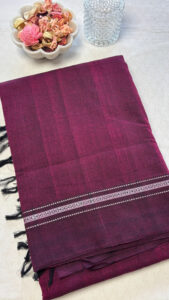
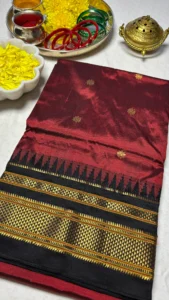
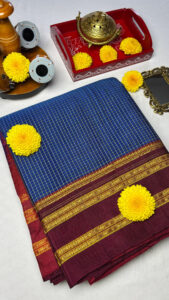
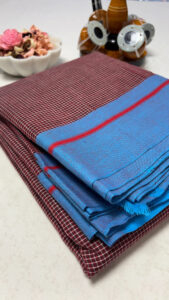
If you are shopping for an Ilkal saree online, you will notice that many sarees use Ilkal-style borders and pallus. It is fair to wonder how you can tell an authentic Ilkal saree from a look-alike. The honest answer is that there is no single trick. What you can do is check a handful of verifiable cues, read the product details closely and ask the seller direct questions. This guide walks through them in plain language.
Start with the place: what “Ilkal” really means
Ilkal is a town in Bagalkot district, in northern Karnataka. The Ilkal saree is a traditional handloom saree of that region and has a Geographical Indication (GI) tag, which is why the word “Ilkal” refers to a specific place and craft, not just a pattern. A saree is described as Ilkal when it comes from that tradition and that origin.
On our own product pages, the Origin attribute reads “Ilkal, Karnataka”, so you can see the claim stated in the same place on every listing.
Cue 1: the GI tag
A GI tag recognises a product as belonging to a particular region and its traditional methods. For an Ilkal saree, it is one of the more meaningful signs to look for. On our pages it appears as the GI Tagged attribute, and you will see it set to Yes on products that carry it. For example, the Gayatri Border Pure Cotton Handloom Ilkal Saree lists GI Tagged as Yes.
Note what a GI line on a webpage is: a statement by the seller. It is reasonable to ask where the claim comes from and how the seller sources the saree. A shop that is confident about its sourcing will be glad to answer.
Cue 2: the Handloom Mark
The Handloom Mark is a mark of the Government of India used to identify genuine handloom products. If a saree is sold as handloom, look for it on the product page or ask whether the saree carries it. Our handloom Ilkal sarees list Handloom Mark as Yes, and the details of the weave are given in the Weave attribute.
It is worth saying that the mark and the weave tell you about handloom, which is slightly different from Ilkal. A saree can be handloom without being Ilkal, and the reverse is also true, so look at both.
Cue 3: the Tope Teni pallu joining
This is the cue most associated with an Ilkal. The pallu, the decorative end of the saree, is woven separately from the body and then joined to it using the traditional Tope Teni interlocking technique. The join is part of the weaving, and is not just a stitched seam.
When you hold an Ilkal in your hands or look at close photographs, check where the pallu meets the body. Ask the seller for a close-up of that join. Our Ilkal descriptions mention it explicitly, as with the Viscose Cotton Handloom Ilkal Saree, where the body and pallu are woven separately and joined through the Tope Teni technique.
The pallu design
The pallu often carries the Tope Seragu motif, which is inspired by the jowar fields of North Karnataka. It is a design cue, not proof by itself, but it is a good sign that the saree follows the tradition.
Cue 4: composition, cotton and silk
Traditionally, an Ilkal has a cotton body, while the pallu and border are silk or art silk. Modern Ilkals appear in several blends, so the thing to check is whether the listing tells you the composition clearly. On our pages you will see:
- Fabric, such as Pure Cotton, Viscose Cotton or Silk Cotton.
- Pallu, where it differs from the body, for example a silk pallu on a cotton body.
- Weave, which says Handloom or Powerloom.
The last of these deserves emphasis. Not every saree that follows an Ilkal design is handloom. Some of our Ilkal sarees, like the Traditional Kasuti Ilkal Saree, are powerloom, and their pages say so. We think this is how a listing should work: you should be able to see the weave before you buy. A seller who lists only “Ilkal saree” with no fabric, weave or origin is giving you less to go on.
Cue 5: the borders and motifs, as supporting signs
Border and motif vocabulary can help you recognise the tradition:
- Gayatri border, inspired by the rounded Rudraksha seed.
- Chikki Paras border, believed to resemble brinjal seeds, though some associate it with stars.
- Kasuti, a traditional Karnataka embroidery, with motifs such as peacocks, elephants, diyas, Tulasi Katte and Hans.
Use these as supporting information. A border pattern can be copied, so it does not confirm authenticity on its own. The GI tag, the Handloom Mark, the pallu joining and a clear fabric and weave description work together.
Questions to ask the seller
If you are unsure, send a message before ordering. A few useful questions:
- Is this saree handloom or powerloom?
- Does it carry the GI tag and the Handloom Mark, and can you show me where this is mentioned?
- What is the body fabric, and what is the pallu and border made of?
- Is the pallu woven separately and joined with the Tope Teni technique? Can I see a close-up of the join?
- What is the saree length, and is a blouse piece included?
- What is the Wash Care label?
- What is your policy on returns?
The last question matters more than it looks. We do not accept change-of-mind returns, and we say so on our returns and refunds page. Check this policy anywhere you buy, since it affects how carefully you should choose.
What we would not rely on
Price alone is a weak signal, because fabric, weave and design all affect it. Photographs alone are also weak, since lighting can change the colour of a saree. We shoot our photographs in natural daylight to keep colours true to life, but we still suggest reading the details alongside the pictures. We also do not recommend home tests to prove a saree’s authenticity. A saree’s documented details and a transparent seller are more dependable.
Putting it together
An authentic Ilkal saree is best recognised through a combination of signs: a stated Ilkal origin, a GI tag, a Handloom Mark where it is sold as handloom, the Tope Teni pallu joining, a clear composition and traditional borders. When those details are on the page and the seller answers your questions openly, you can shop with more confidence.
To see how these details are shown in practice, browse our Ilkal sarees, narrow down to handloom sarees, or explore everything in the shop. If you would like a second opinion, you can reach us from the contact page or on WhatsApp.
Related guides
- Ilkal saree guide: history, weave and how to wear it
- How to care for handloom cotton and silk sarees
- Pure cotton vs cotton silk vs viscose cotton sarees
Shop the sarees in this guide
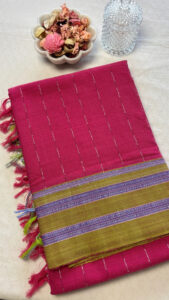
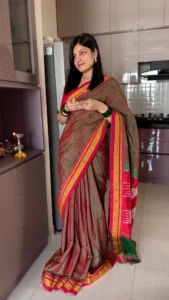
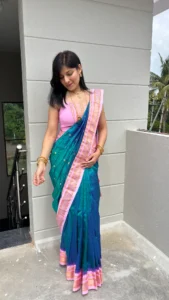
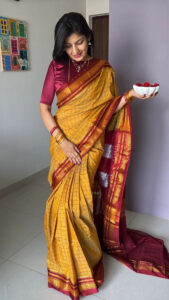
These handloom Ilkal sarees list the GI tag and Handloom Mark on the product page, and one powerloom saree is included for comparison.
 Gayatri Border Pure Cotton Handloom Ilkal Saree Price range: ₹3,399 through ₹3,599
- Minimal Chikki Paras Border Pure Cotton Handloom Ilkal Price range: ₹3,499 through ₹3,699
- Viscose Cotton Handloom Ilkal Saree₹3,099
- Traditional Kasuti Ilkal Saree₹2,799